
Karo - a frontline species for coastal protection
Author: Natalie Spyksma (from Dawn Chorus 140, Summer, February 2025)Photo credit: Jonthan Mower
A plant that had an outstanding flowering season on Tiritiri Matangi Island during the spring of 2024 was Pittosporum crassifolium, better known by its Māori name, karo. As this issue of Dawn Chorus goes to print, the results of this flowering are obvious: big grey seed pods (capsules) are hanging in abundance on karo branches all over the Island.
The pods are attractive. They bob in the wind in tandem with the plant’s leaves, which flicker between the green upper and grey undersides, creating patterns and hues in constant change. Have you noticed their profusion this year?
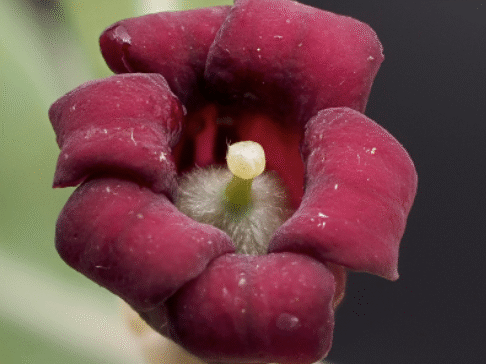
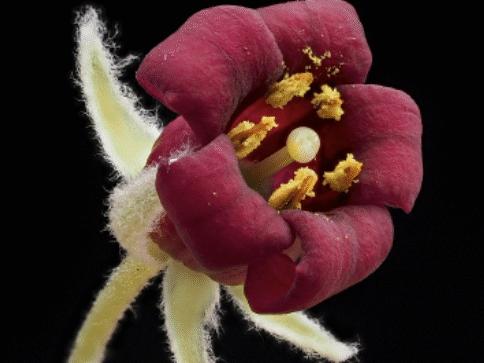
Left: A female flower with one prominent central pistil.
Right: A male flower with pollen-bearing stamens.Photo credit: Jonathan Mower
Island presence
Botanist Alan Esler recorded the first surveyed wild population of Pittosporum crassifolium on Tiritiri Matangi Island in the early 1970s. Before this, rats were present, and animals had grazed the Island for around a century, limiting the survival of many plant species, including karo. Between 1984 and 1994, copious quantities were planted during the Island’s revegetation programme.
Now they regenerate freely in suitable habitats and can readily be seen lining the coastal edges of the track to Hobbs Beach, often in a front-line position, intermingling with harakeke/flax (Phormium tenax), taupata (Coprosma repens), muehlenbeckia and pōhutukawa (Metrosideros excelsa) amongst the boulders on the beach fringes. They also thrive on forest margins, cliffs, and rocky outcrops all over the Island, where larger trees have not stolen their light, and the soil is relatively well-drained.
Distribution
Pittosporum crassifolium grows elsewhere in areas with habitats similar to those of the Tiritiri Matangi population. Its natural range extends from North Cape to Poverty Bay and on many northern offshore islands. They have also naturalised in other warm areas of New Zealand, Norfolk Island, and the Hawaiian Islands, where they may be considered a weed species.
There are around 250 species of Pittosporum worldwide, twenty-one of which, including karo, are endemic to New Zealand. All belong to the evergreen Pittosporacea family.
Growth habit and description
Karo are fast-growing colonisers, able to inhabit coastal positions that few other plants can tolerate. Consequently, they contribute to the overall stability of coastal ecosystems, helping with erosion control and providing shelter for the next layer of vegetation to grow behind.
Within ten years and in ideal growing conditions, they will form into a dense shrub or an erect, multi-branched small tree up to ten metres tall and three metres wide.
Their alternating, thick, leathery, oval leaves (5-7 cm long) curve inwards at the margins, reducing surface exposure to the dehydrating salt-laden winds of their coastal habitat.
They are also covered underneath in downy, grey, felt-like hairs (tomentose) that help prevent salt penetration to the leaf’s surface, another clever survival technique. Tomentose also occurs on the soft new-season growth that readily shoots from branch tips.
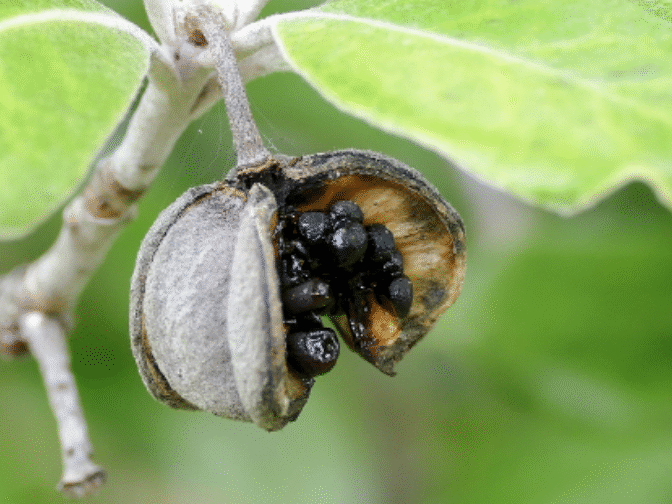
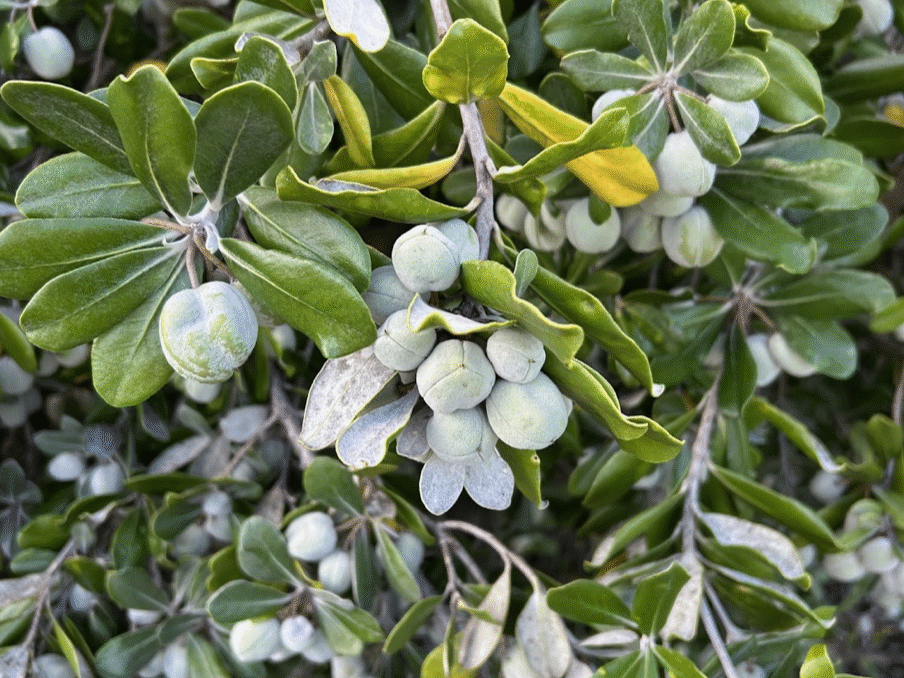
Left: Karo seed pod open showing the sticky karo seeds. Photo credit: Annette de Raat
Right: Karo seed pods. Photo credit: Natalie Spyksma
Bird food—the flowers
In spring, small dark crimson flowers appear in terminal clusters. Their sweet perfume fills the evening air, attracting bees, flies and nocturnal moths to aid pollination.
However, by day, nectar-feeding birds such as korimako/bellbirds, hihi/stitchbirds, tūī, kererū / New Zealnd pigeon, and kākā are lured in to help with pollination – receiving in exchange their fill of sweet sugary syrup from the flowers. Korimako are particularly well-designed for the job.
Close inspection of the pretty flowers will reveal that male and female flowers are on separate plants, the males in larger bunches than the females.
The females have one prominent central pistil (stigma and style atop an ovary). In contrast, the males have an often sterile, small central pistil surrounded by five yellow pollen-bearing stamens (filaments and anthers). In other words, the male flowers are hermaphroditic, or ‘inconstant’ in botanical terms.
When the inconstant male flowers self-pollinate, the resulting seed pods are smaller, and the seed is less viable than those born on karo’s female-flowered trees. Have a look and see if you can notice the difference.
The process of having one flower ‘inconstant’ and the other ‘constant’ (pure) on separate trees is known as gynodioecy. This rare phenomenon is thought to be an evolutionary bridge between hermaphroditism and dioecy (separate male and female plants).
Bird food—the fruit
Compared to its small flowers, karo’s round, 2-3 cm long, three-part seed pods are a significant sight. The male-set pods often hang sparsely and singly, while the female fruit hang in clusters of up to ten. However, most frequently, I’ve observed clusters of two to six. These pods are also covered in protective tomentose, giving them their soft grey/green colour. During autumn and winter, the pods mature and burst open, revealing a mass of black seeds in a sticky yellow substance known as gluten.
Consequently, seed dispersal beyond the tree’s dripline is difficult without external assistance, so seedeaters like tūī, kererū, kākā, kōkako, and kākāriki help with the process. In return for a meal, they inadvertently fly off with the sticky seed attached to their bodies, distributing it—along with the undigested seed—further afield.
Pods can hang onto the tree for up to six months, turning hard and black as they dry out. Maybe you have noticed them.
Enjoy taking a closer look at these important coastal frontliners.