Flora
Between 1984 and 1994, 250,000 - 300,000 trees were planted by volunteers. The island is now 60% re-vegetated, the other 40% being left as grassland for such species as takahē, for views and to protect archaeological remains.The trees planted were, in most cases, raised on Tiritiri Matangi from seeds collected on the island or nearby so as to maintain genetic purity. The wattle trees in Wattle Valley were encouraged as they provide shade for seedlings and are also an excellent source of food in winter for such species as the honeyeaters.
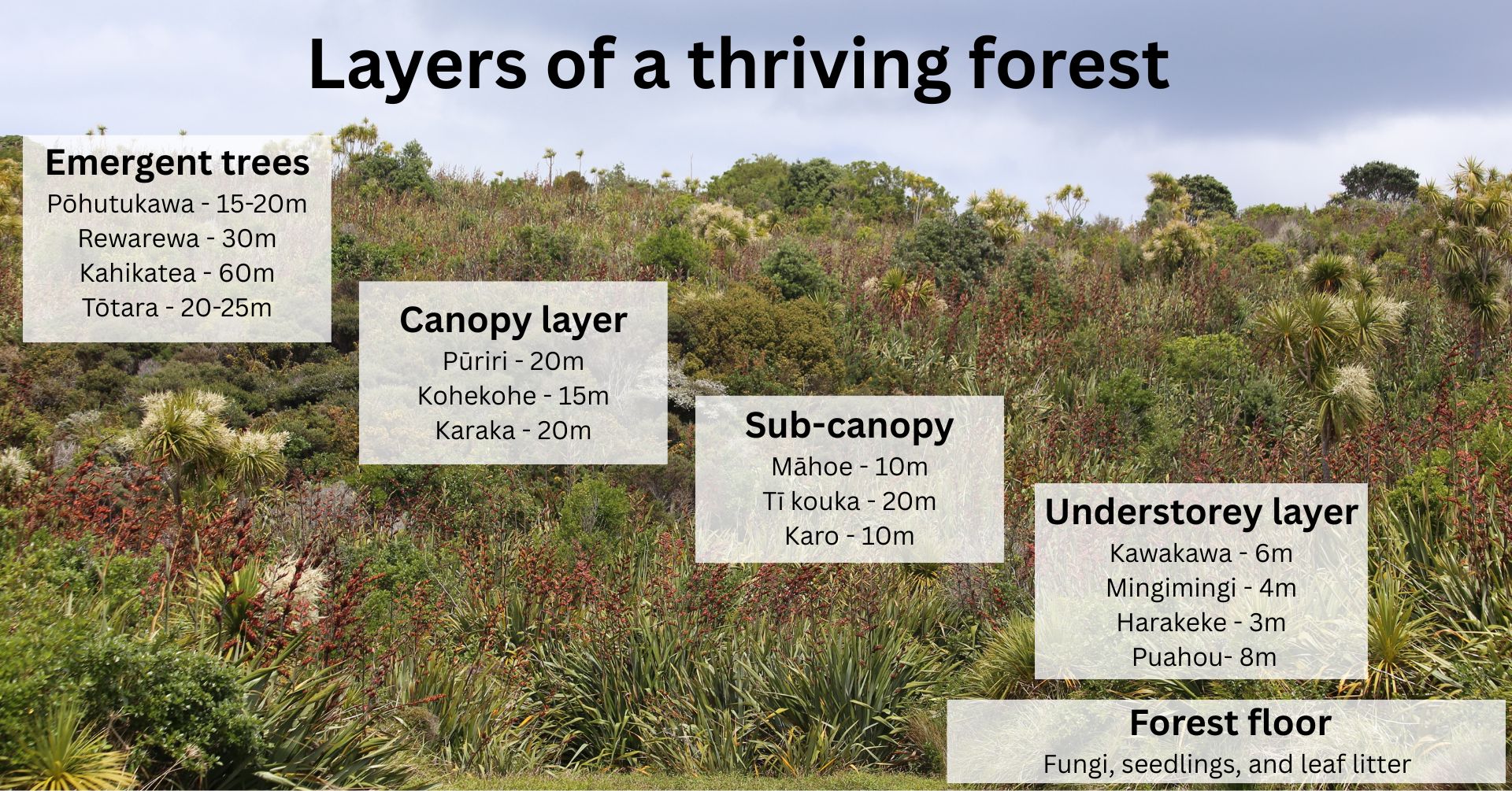
A healthy forest is made up of distinct layers, with plants growing at different heights—from tiny seedlings and ground ferns on the forest floor, to shrubs and young trees in the mid-layer, and towering canopy trees above. On Tiritiri Matangi, this layered structure has returned thanks to decades of restoration. The canopy is now dominated by mature species like pōhutukawa, kohekohe, taraire, and karaka, which provide shelter, food, and nesting sites for birds and insects. These layers work together to support a rich and resilient ecosystem, echoing the structure of Aotearoa’s original coastal forests.
The image below illustrates the forest layers and some of the key native species found at each level on Tiritiri Matangi.
Click the links below to explore each layer of the forest and discover the native species that live there.
A Perfect Fit for United Nations Environment Programme
Tiritiri Matangi is celebrated as an exemplar of global ecosystem restoration, aligning perfectly with the UN’s “Decade on Ecosystem Restoration 2021–2030.” When the UN launched its initiative to prevent, stop, and reverse ecosystem degradation, Tiritiri’s decades-long restoration project—led by community volunteers and rooted in public participation stood out as a pioneering and successful model. Beginning in the 1980s, the island demonstrated what was then cutting-edge: large-scale planting, predator eradication, and reforestation on Crown land. Today, it continues to inspire internationally, and the island proudly carries a personalized UN restoration logo as a symbol of its global significance