In 2015 we celebrated 20 years of hihi on Tiritiri Matangi
From the Tiritiri Matangi Archives, Dawn Chorus 102, August 2015.Author: John EwanHeading photo credit: Neil Davies
Next month it will be 20 years since a successful translocation of hihi – the stitchbird – saw them return to Tiritiri Matangi. John Ewen, who as a student monitored the first birds after they were released, and these days co-chairs the Hihi Recovery Group from his base at the Institute of Zoology in London, looks back on a highly successful project . . . assisted by Harry, a young hihi, who is proud to be the 13th generation of his whānau on the Island.
Hi, my name is Harry and I am the youngest hihi on Tiritiri Matangi. My Tiritiri whānau is 20 years old this September! Can you believe it? I want to pay respect to my great-great-great-great-great-great-great-great-great-great-grandparents who made the trip here from their home on Te Hauturu-o-Toi (13 generations if I have counted right). Although I am proud to be from the youngest Tiritiri generation I am also happy to know that some of my cousins have been living to ripe old ages, the oldest so far being 11 years, so their connections to our founders are much closer. Let’s hope I live to such an age. Maybe I will even be a pioneer myself, getting to establish a new home somewhere else in New Zealand. Anyway, I hear it was a difficult start all those years ago. Forty hihi came on the helicopter that day and found themselves in a strange new land. Within a month very few of us had survived. Only four females and 12 males were left. Can you imagine what happened when it came time to breed? Luckily for me, they did breed, the population started to grow… and here I am. I tell you what, when those first hihi arrived I was pretty worried too.
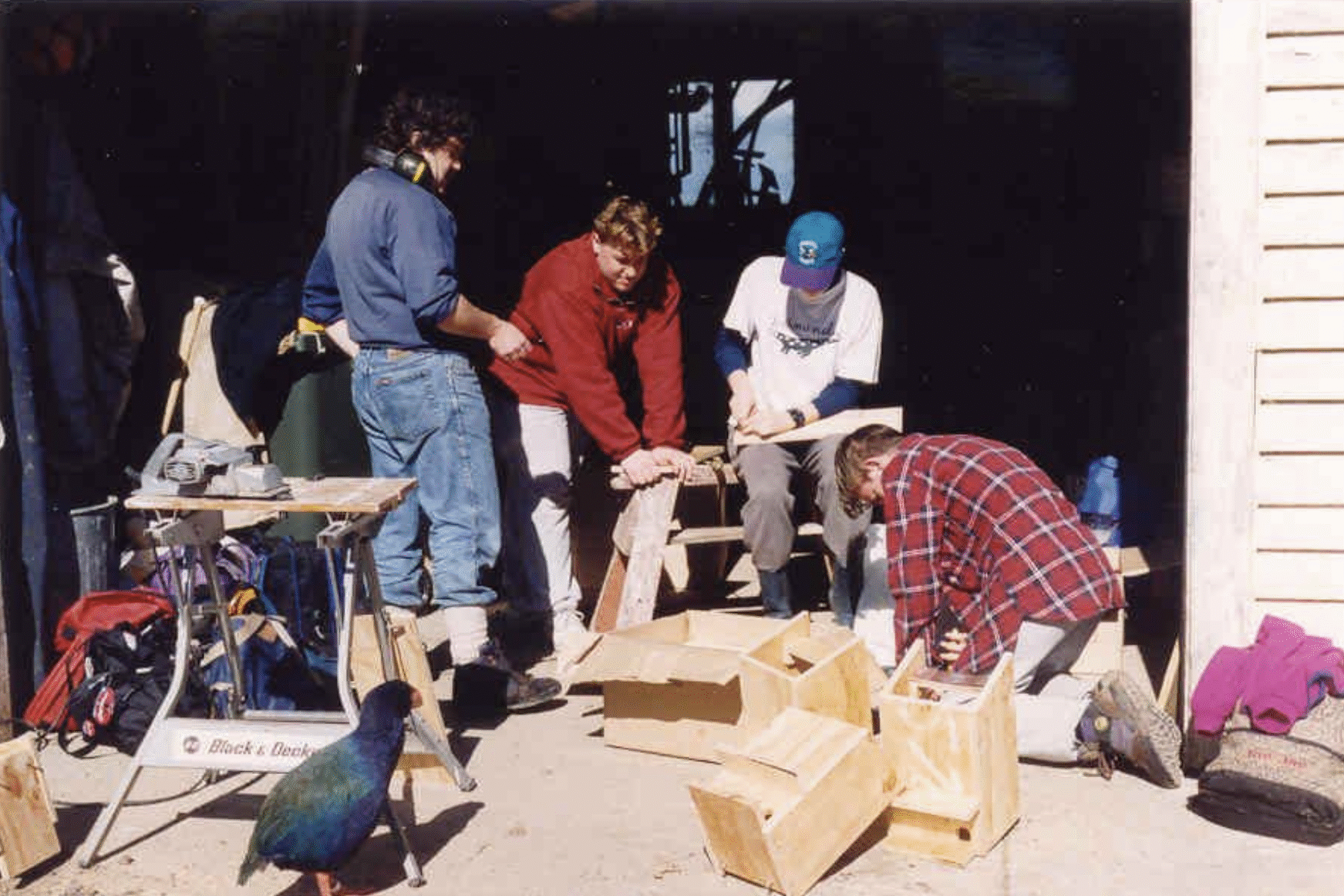


Left: Glenfield College students make the first hihi boxes under the supervision of a curious takaheMiddle: the powhiri for the hihi when they arrived from Te Hauturu-o-Toi / Little Barrier IslandRight: Hihi releasePhotos / Neil Davies, Zane Burdett
My name is John Ewen and I am one of the oldest of the researchers that work with the hihi on Tiritiri Matangi. I was a fresh-faced MSc student monitoring the hihi once they were released on the Island. The release was exciting and had gone really well, largely thanks to Mel Galbraith and a team of students from Glenfield College who planned and led the translocation.
I well remember that September day back in 1995. I was with John Craig and a bunch of supporters and visitors down in Wattle Valley excitedly preparing to let our group of birds go. The hihi were all very happy to get out of their transport boxes and into the forest. But I then had to return to Massey University and exams. I got back to the Island a month later to start my project. I was meant to be looking at how distance to a feeding station would affect how many babies a female hihi could raise. BUT there were no females! Well, a lot fewer than the 20 that had been let go.
What to do? First and foremost was anything to help these birds get a foothold in their new home. We had four females. Luckily each settled on a territory and I spent my days watching and recording what was happening. I set up temporary feeding stations nearby so that they had ample food, and nervously hoped. Breeding! It was full on. We had learnt previously about the crazy sex lives of hihi and this was certainly confirmed, in fact made more intense, because there were so many more males than females.
Studying hihi mating behaviour was also made easier on Tiritiri because the forest is relatively low and open. We found out that hihi hold the world record in promiscuous behaviour in birds! Anyway, six babies were produced that first breeding season, and four of these turned out to be precious females.
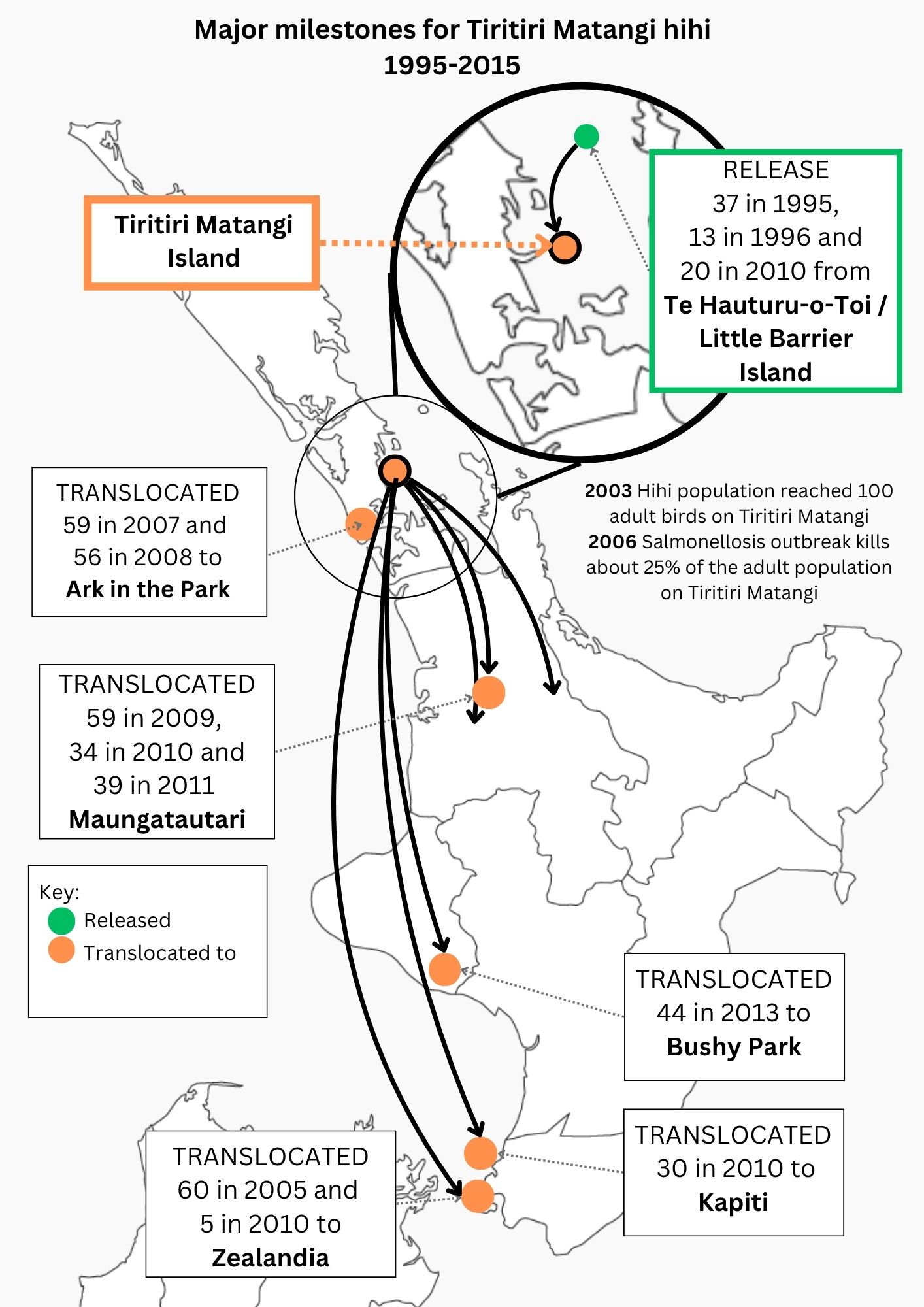
The hihi population on Tiritiri has had two more helicopters full of birds from Hauturu-o-Toi since 1995. The next year we went back to Hauturu-o-Toi to do a top-up translocation and brought over 13 more birds.
After this point the population started to take off. It grew to about 70 adult females and around 160 adult birds in total. We have attempted to keep it at about this size and do so through harvesting mostly juvenile birds to establish new populations elsewhere.
In a further translocation, in 2010, we brought over 20 birds to see how easily we could integrate genetic diversity from Hauturu-o-Toi’s large remnant population into Tiri.
Tiritiri has also become the main source of exports of hihi to start up new populations. The first was to Zealandia-Karori Wildlife Sanctuary in Wellington in 2005.
That makes it 10 years since hihi were first brought back to the mainland of New Zealand, up close and personal to people in a major city, and they came from Tiritiri. I think that is special. Since 2005 Tiritiri has also provided hihi to Ark in the Park, Maungatautari, Kapiti and most recently to Bushy Park. As long as the Tiritiri population continues to do well the birds will continue to be harvested and spread to the best possible sites across northern New Zealand… and maybe further south? With climate change, who knows?
Our Tiritiri hihi have shown amazing resilience and, despite failing to establish in Ark in the Park, they have established, or are showing promising signs of establishment, in all other sites.
But is Tiritiri full? How many hihi could we have on the Island? These are tricky questions. We have not seen evidence for the population regulating itself, ie there is little evidence for density dependence. We have strong and positive population growth. This is, of course, probably artificial. The birds are intensively managed: we feed them; we give them nest boxes; we look after their babies by constantly looking out for and treating infestations of nest mites. As long as we keep responding to the increasing demand of these chores the population could keep growing.
Or could it . . ? We have had some bumps along the way. In 2006 an outbreak of salmonellosis was estimated to have killed 25% of the adult population. There is concern that these types of disease outbreaks might be facilitated by an artificially high density of birds combined with them congregating at feeding stations. Whilst we have little direct evidence for this, the Hihi Specialist Group and the Tiritiri managers have agreed to manage the population at about the 70 adult female level. This is to try and avoid increases in disease outbreak frequency and because the management level required is possible under current resourcing.
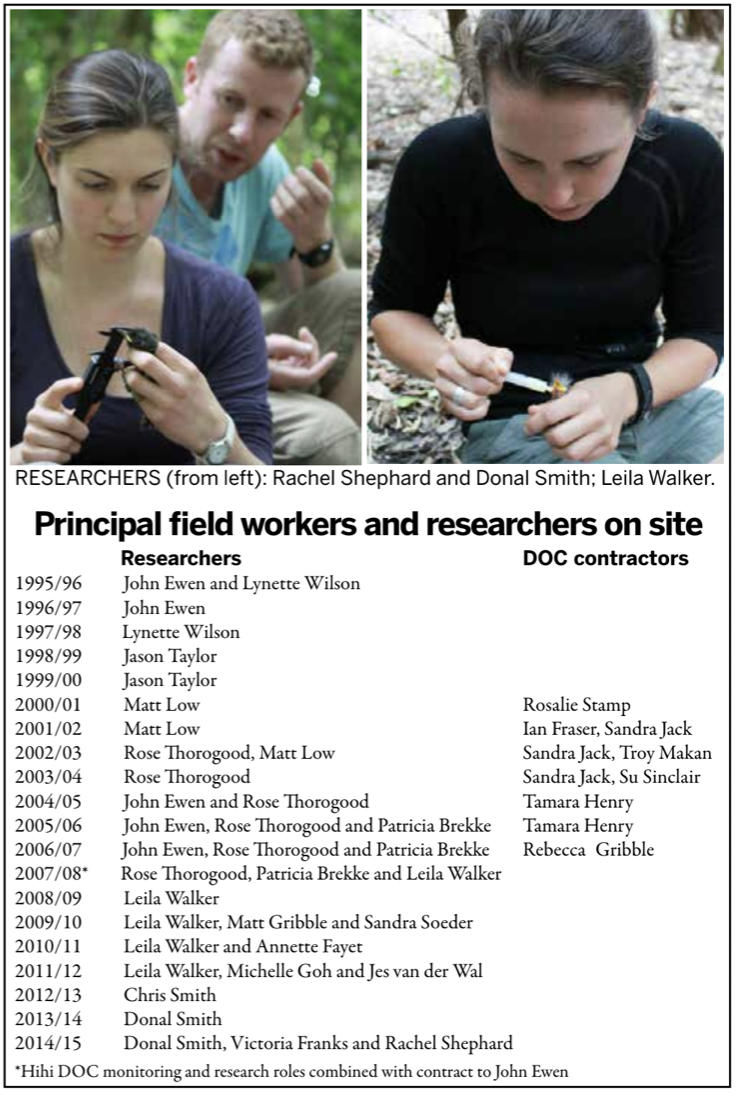
Hihi certainly don’t lack charisma. Over the years they have been near constantly studied and I am sure this is at least partly because of their character. From their sex lives to the meaning of their colourful plumage, from their diet to their parenting skills and most importantly how we best manage this population and species. Every individual is known from birth and tracked until death or translocation elsewhere.
This has resulted in six students completing MSc studies on Tiritiri hihi, five doing PhDs and two more currently under way. An amazing 52 peer reviewed scientific publications are out there based on this one population! Students and researchers come from many countries including New Zealand, United States, Britain, Ireland, Sweden, France and the Netherlands.


Left: Glenfield College students watch the translocation take place.Middle: Mel with Glenfield students.Right: Shaarina Boyd releases one of the first hihi on Tiritiri.Photos / Neil Davies, Zane Burdett
What are some of the strangest things these researchers and others have seen?
– Watching a fertile female for eight hours a day and seeing her constantly chased by the entire population of males (12). The females tried hiding in their boxes or in the feeding cages and, failing that, then crawling along the ground under ferns trying to escape the over amorous attention of the males.
– The gynandromorph hihi that lived on Tiritiri. This is a bird that has female plumage on one side and male plumage on the other – crazy and rare!
– Watching males sneaking into nest boxes to locate females. On one occasion one, then two, then three males entered a box. The last got stuck heading in with its tail and bum poking out. The territorial male then returned and wasn’t happy. We rescued all three birds trapped in the box but you think they learnt their lesson? We doubt it!
– When filming in nest boxes we found a male hihi roosting in a box around the time the female was meant to start laying eggs. But he wasn’t the territorial male – he had snuck in!
– When attempting to collect sperm samples to study inbreeding we tried a freeze-dried female hihi. For some males it worked disturbingly well and we have video footage to prove it. Even when ‘Fluzzy Suzzy’ was looking a bit rough around the edges she could still attract the attention of the boys.
– The discovery that in the breeding season a male hihi’s testes are bigger than his brain. Just as we rightly celebrate the success of this important hihi population and can track its pedigree we can do the same with those who have worked with hihi over the years. My MSc supervisor, longtime Tiritiri hihi and robin researcher Doug Armstrong, is now officially an academic great-grandparent (I am sure he will enjoy reading this!).
There is no sign of any of this slowing down. The more we learn about this little bird the more questions there are. From a conservation angle in particular we are not there yet. Hihi are challenging and we truly believe they remain the acid test for ecological restoration in northern New Zealand.
Hihi means ‘ray of sunshine’ and we like the idea that hihi are just that. They epitomize the challenges and hope for conservation in New Zealand. The Tiritiri project should be proud of its contribution in this light. And a final word from Harry:
The special help those first hihi had from caring people was humbling. Students from Glenfield College along with their then biology teacher Mel Galbraith did a wonderful job of organising the first translocation. Since then we continue to be well looked after with lots of food and plenty of houses for our nests. All this is provided by DOC, SoTM, researchers and volunteers. We also get studied constantly, which is understandable, because we’re really cool and interesting. I am happy about all this because for too long we were ignored and suffered from the changes that accompanied European settlement. By luck a few of us clung on in Hauturu-o-Toi and were protected from the changes that shaped modern northern New Zealand. But now, look at my whānau. We have spread to five new homes and Tiritiri has been the stepping-stone to three of these. Nice.