Conservation Awards Winners
SoTM Conservation Winners
2025 SoTM Junior Conservation Award Winner
Ardmore School Enviro Group
Ardmore School Enviro Group
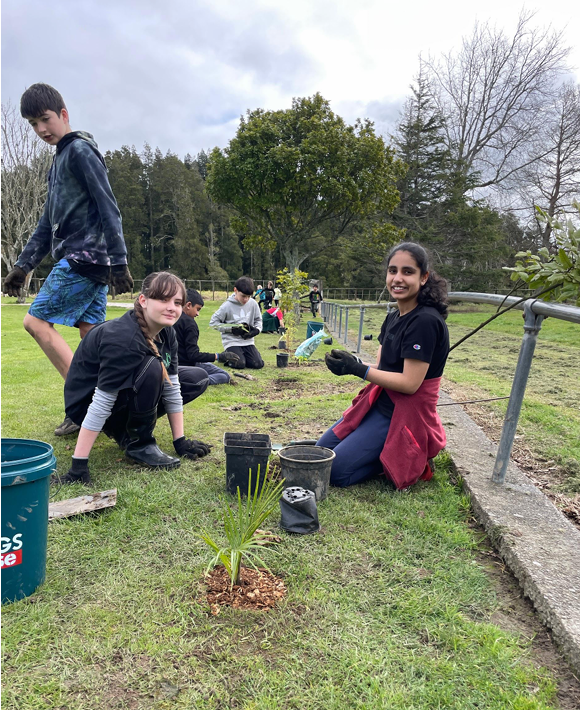
Over the past two years, Ardmore School’s Enviro Group has undertaken significant conservation initiatives inspired by our visit to Tiritiri Matangi in March 2024. Motivated by the native planting there, we planned and implemented a native tree planting project at our school with 30 trees donated by the One Billion Trees Project. Year 7/8 Enviro students educated younger students about native trees and led them in planting our outdoor classroom. Our involvement in the Trees for Survival Program deepened, and seeing the potential long-term impact of forests we plant was highly inspiring.
This year, our focus expanded to growing our own kai, with support from the Oke Charity to build a 12-bed garden, and the school community contributed through a Saturday working bee. We aim to extend this initiative through the Garden to Table program, engaging all students in hands-on learning. Enviro leaders also introduced junior students to conservation through the Eyes on Nature Program and ran a week of lunchtime activities for Conservation Week, including art, scavenger hunts, bird surveys, and rubbish clean-ups. Moving forward, our goals are to continue planting native trees, develop our garden program, and inspire younger students to actively participate in conservation and embrace their role as kaitiaki.
2025 Winner of the SoTM Award NIWA Science and Technology Auckland City Schools Fair
Vani Singh, from Epsom Girls Grammar
Project: ‘Altering Ecosystems’
Climate change is affecting soil pH in New Zealand, impacting plant growth. My aim was to test how different pH levels affect plant growth using hydroponics, exploring it as a sustainable solution for environmental shifts. I investigated four groups, each with a different pH: the control, optimal solution, acidic and basic solutions. After two weeks, I found the optimal pH range (6.0-6.5) showed the best growth and root development, due to better nutrient availability. My microscopic analysis revealed nutrient storage vesicles in optimal and acidic groups unlike basic and control groups. My findings highlighted pH’s important role in sustainable agriculture across New Zealand.
2024 SoTM Junior Conservation Award Winner
Kaia Dick Y8 from Whangaparāoa School
Kaia Dick
Year 8 Whangaparāoa School
Kaia is an amazing kaitiaki who works hard to support native plant and animal life. She is part of the school’s pest-free team and weed-buster team and turns up with great enthusiasm and encourages others. Kaia is a great nature ambassador and attends gala days and community events promoting conservation. She is interested in the bird and insect species on Tiritiri Matangi and is inspired to help create a pest-free environment on the Hibiscus Coast.
2024 Winner of the SoTM Award NIWA Science and Technology Auckland City Schools Fair
Eva Yarrow, Year 11 from Mt Albert Grammar
Project: ‘Aphid Attack’
Biological agents are currently a growing alternative pesticide method in NZ agriculture, but methods used by Māori in pre-colonisation agriculture remain underdeveloped. My aim was to test the potential of native plants as biocontrols, by investigating Peach aphids’ reactions to certain plant extracts. I investigated the biological control effect of four natural plant extracts, Kawakawa, Manuka, Kumarahou, and Horopito, comparing aphid’s migration patterns when exposed to these extracts compared to those who have been exposed to modern pesticides. After a 24-hour observation period, I discovered that Kawakawa and Horopito have the potential to repel aphids.
2023 SoTM Junior Conservation Award Winner
Wanika Chetty Y8 from Manurewa Intermediate
Wanika Chetty
Year 8 Manurewa Intermediate School
Wanika was one of the very first students to sign up to her school’s Nature Club.
She is one of the best Eco Councillors with helping in the gardens, with the animals, running our trapline, composts, fruit kitchen, rubbish system, mentoring the Year 7s, and does the yuck jobs and always with a smile on her face! She is one of the best Eco Councillors, who through her commitment and passion for nature has made this Nature Club a success.
2023 Winner of the SoTM Award NIWA Science and Technology Auckland City Schools Fair
Rosie Bilkey, from St Kentigern Girl's School
Project: ‘Weather Versus Water’
My project was on measuring the relationship between rainfall and water quality (including nitrate levels) in my local stream.
“more information to come”
2022 SoTM First Equal Junior Conservation Award Winners
Maddison Smyth Y8 from Northcross Intermediate & Tyler Griffiths Y6 from Summerland Primary
Tyler Griffiths
Year 6 Summerland Primary School
Tyler represents the future of success of our young rangatahi in conservation-he is highly motivated and earnest in his quest to show kaitakitanga for the environment and respect for our precious native species.
As a young conservationist Tyler is committed to taking personal action to protect and restore the environment in any way he can. His teachers have seen his enthusiasm and dedication from a very early age as he shared his thoughts, ideas and actions with those around him. He has become a role model for his peers in the humble and enthusiastic way he has applied himself to action in the environment. Students want to be around him and learn from him and take the lead from him. (He has been an ”influencer” long before it became fashionable on social media!)
Maddison Smyth
Year 8 Northcross Intermediate
Maddison has been an outstanding member of our school Enviro Group for two years. In that time she has attended weeding workshops, visited a native tree nursery to gain skills for propagating seeds and caring for seedlings. She is currently managing a tracking and trapping group for both our school ngahere and the Northcross Reserve council land. Maddison often guides younger members of our team when working in the Reserve.
2022 Winners of the SoTM Award NIWA Science and Technology Auckland City Schools Fair
Cassidy Foster and Mackenzie Leighton, Year 8, from St Dominic's Catholic College
Project: ‘Less Pests, More Birds?’
The project aims to establish whether there is a connection between the amount of pest control and the number and variety of native birds in an area. We wanted to test whether pest control is actually a worthwhile project, and our results were very positive!
We went to 3 different locations with varying levels of pest control, from Kitekite falls track where there is no current pest control, to Tawharanui with its extensive pest control efforts including a pest fence surrounding the sanctuary.
We found with increased the levels of pest control the number and variety of native birds present increased drastically. We tested this by doing a series of bird counts in different locations around our chosen area to get as accurate a picture as possible.
We hope that our project can inspire people to continue or begin pest trapping of their own, and increase support for pest control initiatives such as Ark in the park (our 3rd test site), Tawharanui, Tiritiri Matangi, and many others throughout the country.
2021 SoTM Junior First Equal Conservation Awards
Eve Dale Y2 from Edendale Primary School & George Willans Y6 from Summerland Primary
Eve Dale
Year 2 Edendale Primary School
Eve is an influential environment leader because she approaches all her environmental tasks with great spirit and initiative. She is an inspirational role model to others. She volunteered to go on What Now for a segment on how to reduce waste.
Eve offered tips on; how to cook popcorn from scratch rather than buy plastic covered food like chips and how to use soap bars instead of liquid soap. She fronted this segment like a STAR with lots of her own flair! Eve is a passionate member of the local Eco-Neighbourhoods group and helps out flora and fauna at home by making bird feeders and doing gardening.
George Willans
Year 6 Summerland Primary School
George Willans became part of the ‘Summerland Primary School-Mammalian Predator-Free team’ as a Year 5 student in 2020. In the years before joining the team, George’s teachers had already noted his passion for the environment.
Soon after joining the school team, he started reporting back to their meetings and sharing the steps he was taking to implement predator control in his own patch and beyond. It was obvious that George was on a mission- one of his own making. He is quietly ambitious about making a difference, one rat, mouse or stoat at a time
2021 Winners of the SoTM Award NIWA Science and Technology
Auckland City Schools Fair
William Nand and Aria Holland - Year 8 Kings School
Project: ‘Tūī Tunes’
The students carried out a practical inquiry that unveiled many interesting discoveries in how the area a tūī lives in affects its song when looking at rural, urban and city park environments. Alongside this, it was found that temperature and time of day significantly affect trill, average dynamics, loudness range and volume.
The results show that the lower the temperature at recording sites, the greater the average trill/ minute and the loudness range (LU). Differently, the higher the temperature the greater the average dynamics (LU) of song.
The students found that the earlier the time of day, the greater the trill/60 seconds, volume, loudness range and average dynamics was 15 trill in song, while from 12-15 pm there was an average of 7 trill.
2020 SoTM Junior Conservation Awards
Dylan Lewis
Year 7 Mahurangi College, Warkworth
After a visit to his school from Forest and Bird, Dylan decided to support his community by trapping rats, mustelids and possums in his local area. He began trapping at home in 2018 and then, after discussing with his neighbours, he began trapping in his local neighbourhood from October 2019. He has also volunteered in 2020 to be a part of the trapping team working in the Mahurangi College Bush restoration project.
Dylan initiated trapping to save the dotterel population at Snells Beach and shared his story with the class and in his previous school of Warkworth Primary School. He has assisted Michelle Mackenzie with dotterel protection in Snells Beach. Dylan volunteered to assist with the trapping team in the working in the Mahurangi College Bush restoration project. Dylan traps for his local community, his school community and he assists in local conservation projects when he is able.
2020 Winner of the SoTM Award NIWA Science and Technology
Auckland City Schools Fair
Amelia Simmons
Year 8 Michael Park School, Ellerslie.
Project: ‘Bright Wings’ A study on Butterflies
Amelia chose to do a project on Monarch Butterflies when at home during lockdown. She could study them more closely than when being at school. She loves Monarch Butterflies in that they stand out from so many things due to their striking colours. Each one she looked at seemed to have a different personality: some were shy, quiet and others were on the go the whole time
2019 SoTM and Fullers Junior School Science Award
Ethan Raymond
Year 8 Randwick Park School
Ethan has been a hands on member of the Enviro-Warriors team since its beginning four years ago. He has taken on the role of leader, remembering to ‘do’ the litter-free area award audit prior to full school assemblies, mentoring a younger student to learn the role.
He is proactive in bringing up environmental issues as they arise around the school and poses solutions. He has been instrumental in the success of our orchard by feeding the trees worm castings and mulching. He has attended an after school pruning course at the Auckland Botanical Gardens. He has been a great asset to our enviro programme and in building sustainability awareness within our learning community.
2019 Winner of the SoTM Award NIWA Science and Technology
Auckland City Schools Fair
Abby Haezelwood
Year 8 St Kentigerns Girls College
Project:’ Plastic Beaches’
Abby Haezelwood with her winning Science Exhibit on Plastic Beaches at the NIWA Taihora Nukurani Auckland City Science Fair in September 2019. Amy looked at nine beaches around Northland and Auckland analysing the plastic present. Her exhibit was displayed at the Visitors Centre on Tiritiri Matangi.
2018 SoTM and Fullers Junior School Science Award
Gabriel Barbosa
Year 5 Summerland Primary School
Gabriel is an incredibly enthusiastic member of the Mammalian Predator-Free team at Summerland Primary School. Gabriel has been instrumental in setting up a programe to track, map and trap invasive mammalian predators at our school.
Every week throughout the year he has met with the other team members and his passion for the project has never lessened. He shows commitent to learning as much as he can about ways to protect our native bird species in particular and his enthusiasm is infectious-whether he’s making tracking tunnels and bird feeders or explaining to other students aspects of biodiversity relationships.
2018 Winner of the SoTM Award NIWA Science and Technology
Auckland City Schools Fair
Annika Lints
Year 8 Kohia Terrace School
Project: ‘Are Mussels in Hot Water?’
In this project Annika investigated if mussels could filter the water in different temperatures above and below the average saltwater temperatures. From the results she discovered that mussels filter through any temperatures but the coldest temp (11⁰C) took the longest and at the warmer temperature (23⁰C) was the shortest filtering time taken.

Bringing light to part of Tiritiri Matangi history
Bringing light to part of Tiritiri Matangi history
Author: Jonathan MowerDate: 23/04/23
On January 1, 1865, the new and then richly red Tiritiri Matangi lighthouse first shone its light over the Hauraki. Although that light has been continuously operational since that day, how the light has been generated has changed many times. First lit by colza/canola oil, it changed consecutively to using paraffin, and acetylene, then to electricity first from diesel generators, then from a cable link to the national grid, then reverted back to diesel generators and ultimately to solar power with diesel generator backup as it remains today.
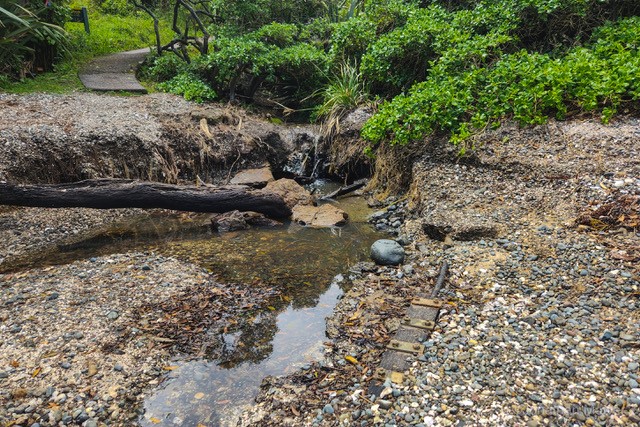
Cyclone Gabrielle and other weather events in February caused deep scouring to parts of the island’s coastline and in doing so brought to light part of this history when it uncovered parts of the submarine cable that in 1967, linked the island to the national grid and ended years of diesel power generation. Laid across the sea bottom, the cable stretched in a loop from Pink Beach near the end of Whangaparaoa Peninsula, across Whangaparaoa Passage to Tiritiri Matangi Island where it exited at the northern end of Hobb’s Beach and travelled inland.
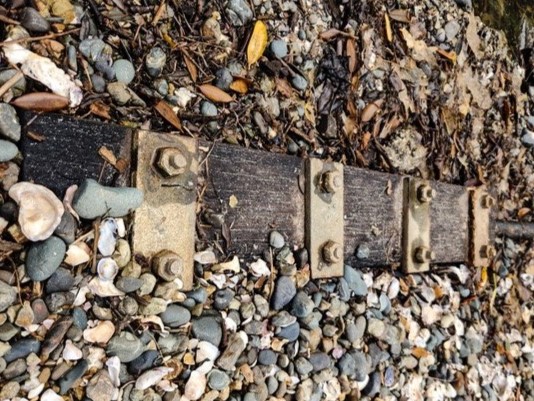
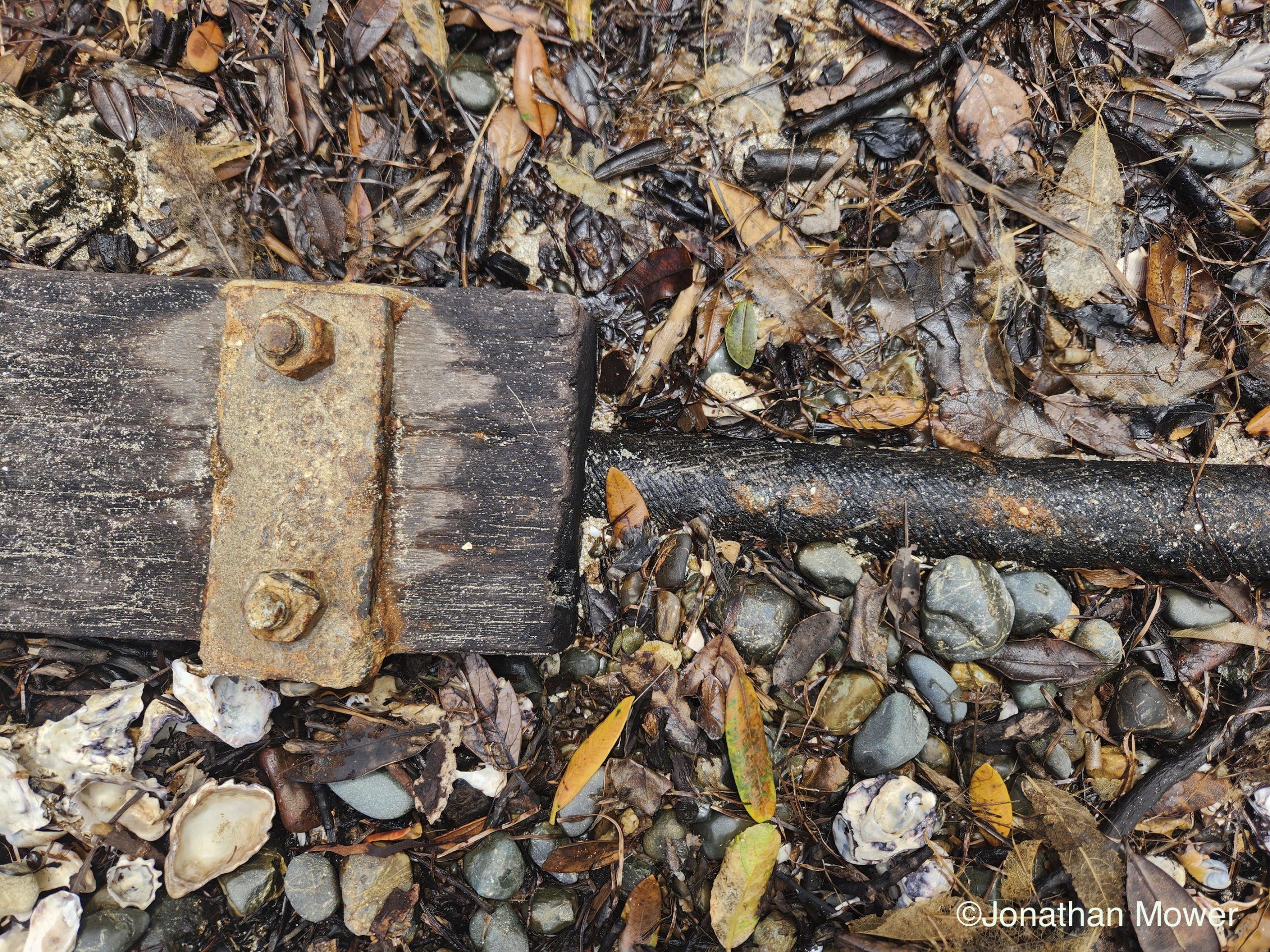
The mains cable was actually two seperate cables; the marine cable and the land cable and the two were joined within a bolted and braced wooden structure.
Although the laying of the marine cable was said to have required meticulous planning but it went without a hitch,’(1) maintaining the power connection was not so simple. Marine cables are prone to be damaged by fishing boats and other vessel’s anchors and Tiritiri Matangi’s cable proved no exception. Sometimes the damage would cause cable failure and for Tiritiri Matangi, this was a serious issue as it meant a loss of power not only to the island’s facilities but also to the lighthouse which required an urgent switch to backup generation. Recently Ray Walter, the island’s last lighthouse keeper, recounted one such failure that he discovered while milking. “I was milking the cow, and the cups kept falling off, so I went and had a look, and we had lost one of the phases from the power.”
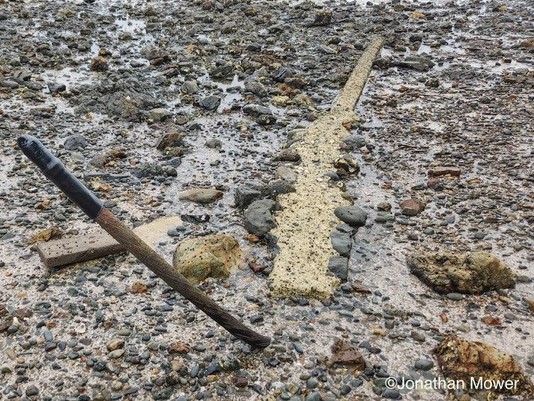
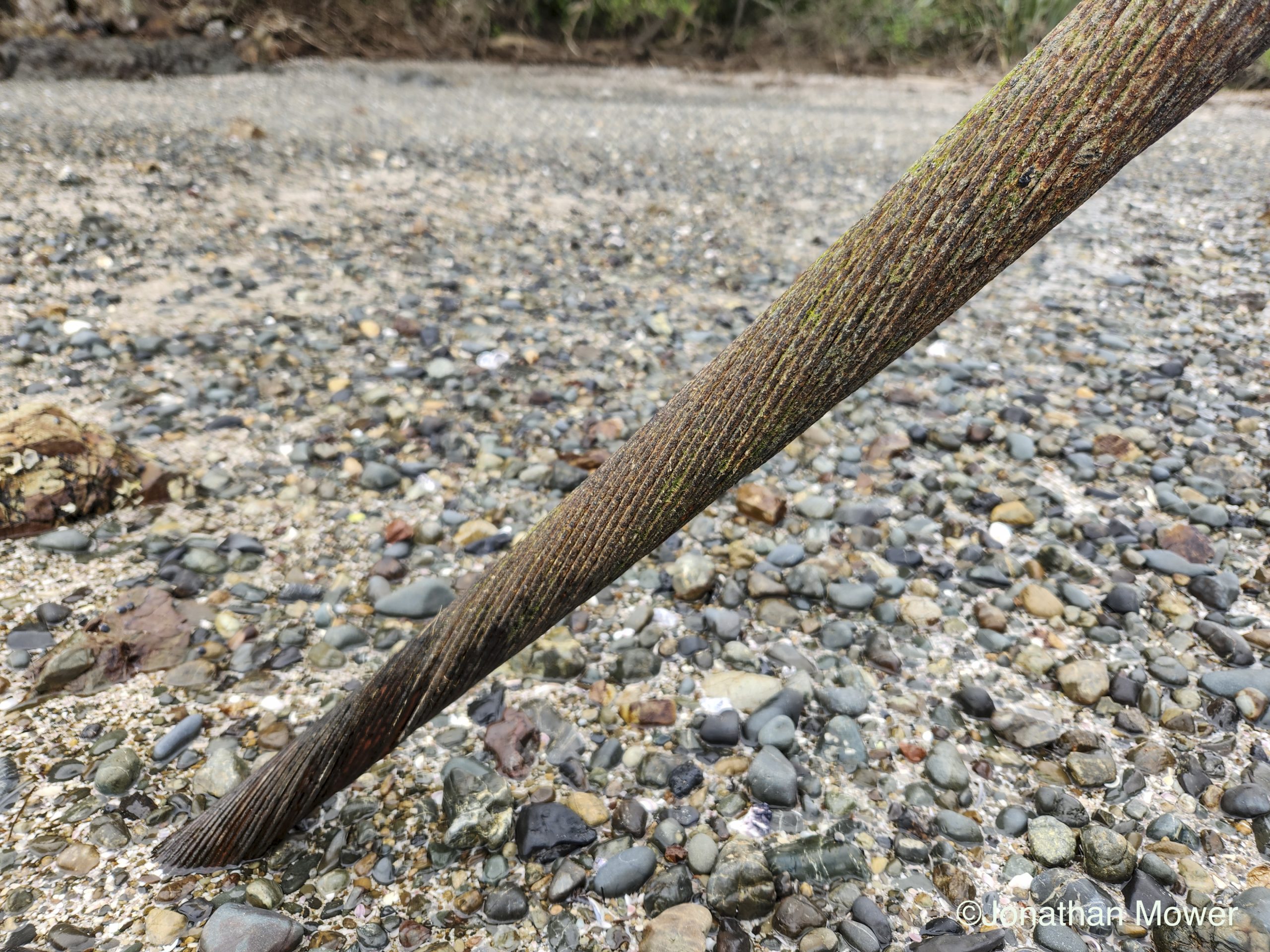
The marine cable exiting the Whangapraoa Channel and arriving onto Hobb's Beach shoreline. The cable is armoured with spiral metal braiding that protects the conductors within the cable but even that was not sufficient to prevent damage by boat anchors.
In 1989, after the cable had failed for the third time, the island was removed from the national grid, and the island reverted to diesel generator supply where it remained until 1990, converting to solar power generation with diesel backup as it remains today. This was not the first cable to connect Tiritiri Matangi to the mainland, however, a marine telephone cable was laid from Waiwera to the island in the mid-1880s using funds donated by Auckland businessmen. Terminating at a small glass, octagonal-shaped phone booth with a curved pagoda-shaped roof, sited on the slopes south of the lighthouse. The telephone line linked the island to the mainland until not long after 1928 when it was lost in a storm. Sourced “Tiritiri Matangi, A Model of Conservation” 2009, by Anne Rimmer.
(1) Jack Gladwell, ‘Mains Power to Tiri Tiri Island’, Ministry of Works Gazette, vol. 4, no. 3, September
1967
Book Launch - The Lights in My Life Sunday 5th October
Book Launch - The Lights in My Life Sunday 5th October
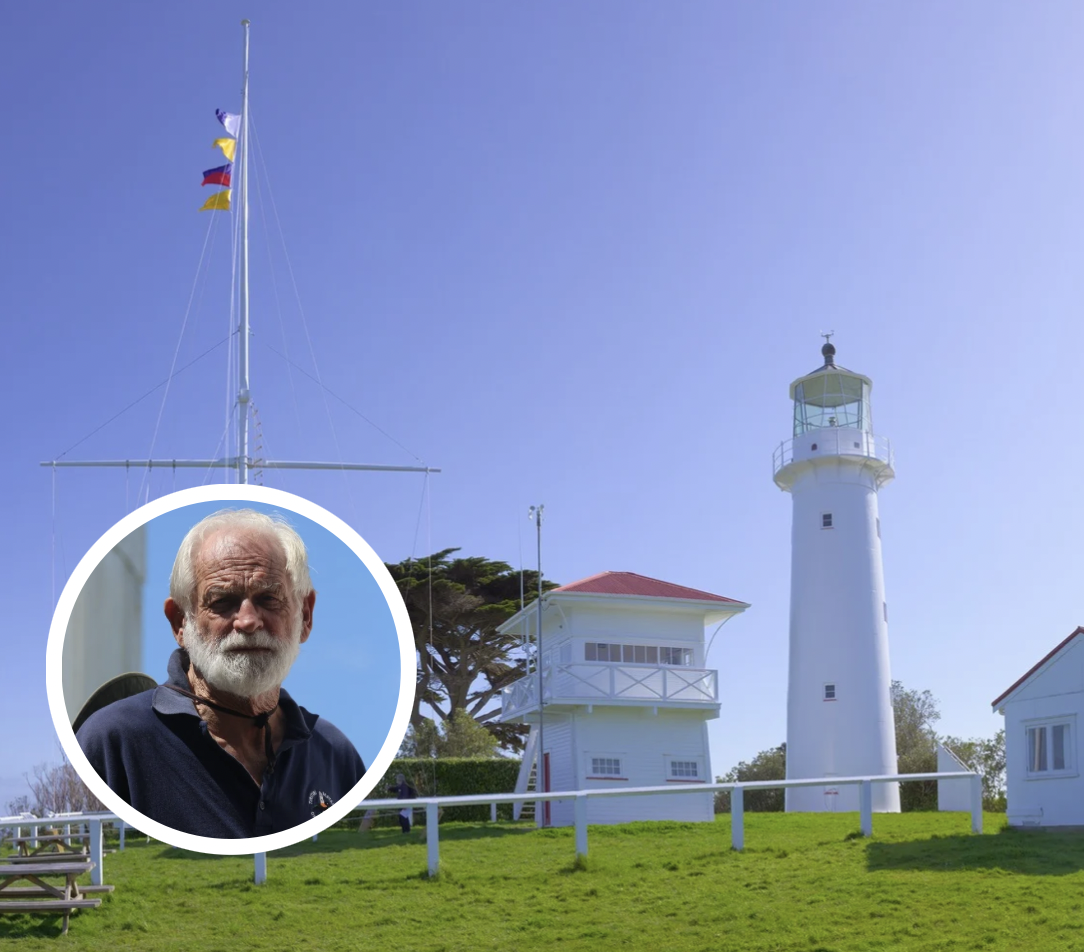
Join us on Tiritiri Matangi Island to celebrate the launch of “The Lights in My Life”, the memoirs of Ray Walter — the island’s last lighthouse keeper and a passionate conservationist behind the island’s successful planting programme in the 1980s and 90s.
The Tiritiri Matangi Lighthouse, built in 1865, is New Zealand’s oldest working lighthouse and was once one of the most powerful in the Southern Hemisphere. Its 32-metre cast-iron tower guided countless ships safely through the hazardous waters of the Hauraki Gulf for over a century.
On launch day, explore the Lighthouse Museum housed in the historic keepers’ cottages, step inside the first floor of the lighthouse, and hear stories that capture a bygone era of maritime history. Ray’s memoirs, completed by author Anne Rimmer with the support of the Walter family, offer a rare and heartfelt glimpse into life as a lighthouse keeper.
This is a unique opportunity to connect with New Zealand’s maritime heritage and celebrate the legacy of one of Tiritiri’s most dedicated guardians. The book will be available for purchase exclusively on the island.
Come along and be part of this special day!

Tiritiri Matangi Dawn Chorus
Tiritiri Matangi Dawn Chorus 4th October 2025
This is a unique opportunity to start the day with New Zealand’s original dawn chorus surrounded by native bush and birdlife as the sun rises over the beautiful Hauraki Gulf...
Every spring, the Supporters of Tiritiri Matangi, in conjunction with Explore Group and the Department of Conservation, organise a special early morning ferry for visitors to experience the Tiritiri Matangi Dawn Chorus.
Spring is the very best time to visit the island for the Dawn Chorus – immerse yourself in birdsong surrounded by rare birds and native forest as the sun rises…and with a little luck you may even hear the exclusive kōkako!
Departs Auckland: 4:00am | via Gulf Harbour: 4:55am | Arrives Tiritiri Matangi Island: 5:20am
Departs Tiritiri Matangi Island: 10:00am | via Gulf Harbour: 10:25am | Arrives Auckland: 11:15am
Please be at the wharf 15 minutes prior to your confirmed departure time
7 hours
AGM
Supporters of Tiritiri Matangi AGM 2025
Welcome to the Supporters of Tiritiri Matangi Inc 2025 AGM.
15th September 2025 7.30pm
MinterEllisonRuddWatts Seminar Room, PWC Tower, 15 Customs Street West, Auckland City
A quorum of 30 voting members is required so we encourage members to attend the meeting. However for those unable to attend, but who wish to observe the meeting please use the following information below to join via Zoom on the day.
Proposed changes to the Constitution
Thank you to everyone who sent in feedback on the draft new Constitution for the Supporters of Tiritiri Matangi.
The feedback has been reviewed by the Board, and some minor changes made.
This is the final draft HERE. – and this is the document that the Board proposes should be adopted by the members at the AGM.
The motion will be: “That the members of the Supporters of Tiritiri Matangi Incorporated formally approve the new Constitution dated September 2025”
Online open: 7:15pm NZST
Meeting start: 7:30pm NZST. – Please arrive by 7.15 so we can start promptly at 7.30
Meeting end: 9:00pm NZST (Anticipated)
The Zoom link is HERE
Please Note: The AGM audited accounts for 2025 have been added to the Reports page.
Notified business is to be submitted to the Secretary at least 5 days prior to the AGM. Please email your submission to secretary@tiritirimatangi.org.nz
2026 Photo Competition
Tiritiri Matangi 2026 Photographic Competition
It is that time of year again when we are looking for entries to our photographic competition (and photos for our 2027 Calendar which raises over $10,000 for the Island).
We have 5 categories –
All photos must have been legally taken on Tiritiri (e.g. drone photos are not permitted) –
- Fauna
- Flora
- Landscape/Seascape
- People on Tiritiri
- Under 16 years Old
You can enter 4 photographs in each category. Please email them as attachments to photocomp@tiritirimatangi.org.nz before April 30th. We will have an independent judge from the NZ Photographic Society and all photos must be able to be used for the promotion of Tiritiri Matangi.
Photo by 2025’s competition winner, Nicole Koch. Congratulations, Nicole!
To help us enter your photos:
1. Photos can be any size & must be attached to the email (not just copied) – 1 to
5MB is good. It’s OK to send several emails. (.heic files cannot be accepted)
2. Photos should not be zipped
3. Please save the photos with a name:
AA CC XXXXXXX
CC = category
FL Flora/plants
FA Fauna/animals
PE People
LS Landscape/seascape
YP Under 16
XXXXXX = Photo description (e.g. Tui, Hobbs Beach, kowhai, flower)
For example, if Jenny Smith took a photo of a bellbird: JS FA Bellbird
Peter Topp had two kowhai flower photographs: PT FL Kowhai 1; PT FL
Kowhai
Condition of entry The Supporters of Tiritiri Matangi Inc (SoTM) acknowledges that photographers own the copyright in their images in accordance with the NZ Copyright Act 1994. It is a condition of entry that you grant SoTM limited free use of your images in accordance with our new Image Use Policy which restricts usage to SoTM purposes only including for our calendar. Full details of this new policy are available on our website @ https://www.tiritirimatangi.org.nz/image-use-policy/
Pōpokatea
Pōpokatea
Despite their size, these birds have a good set of lungs on them and can be found in noisy flocks flitting through the canopy. In the North Island the pōpokatea/ whitehead is the main host to the koekoeā/long-tailed cuckoo who lays its eggs in their nest. Once hatched, the young koekoeā then evicts the host’s eggs and chicks and is raised alone. The pōpokatea continues to feed the koekoeā as if it was their own, even though it is much larger than themselves!
Miromiro
Miromiro
Over a dozen birds have been translocated onto Tiri – though only one has decided to hightail it back home – the miromiro or tomtit. After their translocation to the island in 2004, it appeared that they had disappeared. Soon afterwards, these midget birds were found to have winged it all the way to the Hunua ranges – 60 kilometres away. Things have changed now though, and there are regular sightings of a resident miromiro or two.
Mātātā
Mātātā (Fernbird)
More like a mouse than a bird, visitors are more likely to hear the ‘call and response’ tick/tack between pairs than see a mātātā/fernbird. These small sparrow-like birds are fitted with a long tail measuring half their size which means they typically only fly short distances. The Tiritiri population were originally rescued from the path of the Northern Motorway. Using recordings of their call, conservationists managed to lure a small population from this threatened piece of land and helicoptered them to their new island home. Those 13 birds have now formed a robust population.
Kōtare
Kōtare
As you walk from the wharf towards Hobb’s beach you may notice the banks are dotted with holes. Look closer and you’ll find you’re looking at a kōtare/kingfisher housing estate. To create these burrows, kōtare repeatedly fly headlong into the bank piercing the mud with their dagger-like bill! Once a purchase point has been created they will continue to dig with their beak forming an upward-sloping tunnel, and then a chamber in which they will nest. Although the name kingfisher suggests a diet consisting mainly of fish, these birds will eat almost anything, including skinks, crabs, small birds and even mice.