
Our friendly forest giant with the prickly leaves, useful bark and sweet, juicy fruit
Author: Warren BrewerFrom the Tiritiri Archives, Dawn Chorus 100, February 2015Photo credit: Warren Brewer
Warren Brewer reports on one of New Zealand’s largest and most useful trees, the mighty tōtara, good examples of which can be found on Tiritiri Matangi . . . though they still have some growing to do.
Tōtara (Podocarpus tōtara) occurs throughout New Zealand, extending as far south as Stewart Island. It is one of the giants of lowland forests, growing up to 30m tall with trunks 3m in diameter.
On Tiritiri Matangi we have some mature trees, the largest example being about 10m tall with a basal diameter of 80cm. It is associated with another tree of around 30cm diameter and several saplings 4-6m tall. These trees are in the Bush 1 forest adjacent to the aptly named Tōtara Track. A few saplings and many seedlings occur in other forested areas.
Tōtara is classified as a conifer (meaning cone-bearing). It is dioecious, with male and female cones on separate trees. Male pollen cones (1-2cm long) appear in spring either singly or in clusters and pollen is released as the cones ripen in late spring.
The seed cones in female trees occur singly on a leafless stalk. As a seed matures this basal green stalk swells to form a pale red fleshy receptacle. This makes a reward for visiting birds as they also swallow the attached seed along with the juicy receptacle. Maori also gathered this succulent fruit.


Left image: A noble tree: Elegant saplings in Bush 1
Right image: Typical stringy bark on a mature tōtara also in Bush 1
Tōtara leaves are narrow and pointed, making them prickly to touch. The name tōtara is said to mean ‘prickly’. Tōtara bark is very distinctive, being thick, furrowed and stringy. It can be separated in narrow strips which could be woven into food baskets. It was also used as thatching for dwellings and for making fire.
Māori valued the timber in tōtara trees as it has an attractive reddish-brown straight grain, splits readily and, once dry, its heartwood is very stable. The timber is easily worked, durable and lasts indefinitely in above-ground use. It is also long lasting in saltwater.
Māori used it to build the outer defences and inner dwellings of pā sites and with greenstone and obsidian adzes they shaped ocean going canoes from whole trunks. European settlers used tōtara timber for post and batten fencing, house piles, telegraph poles, sleepers, marine piles, shingles, sashes and doors.

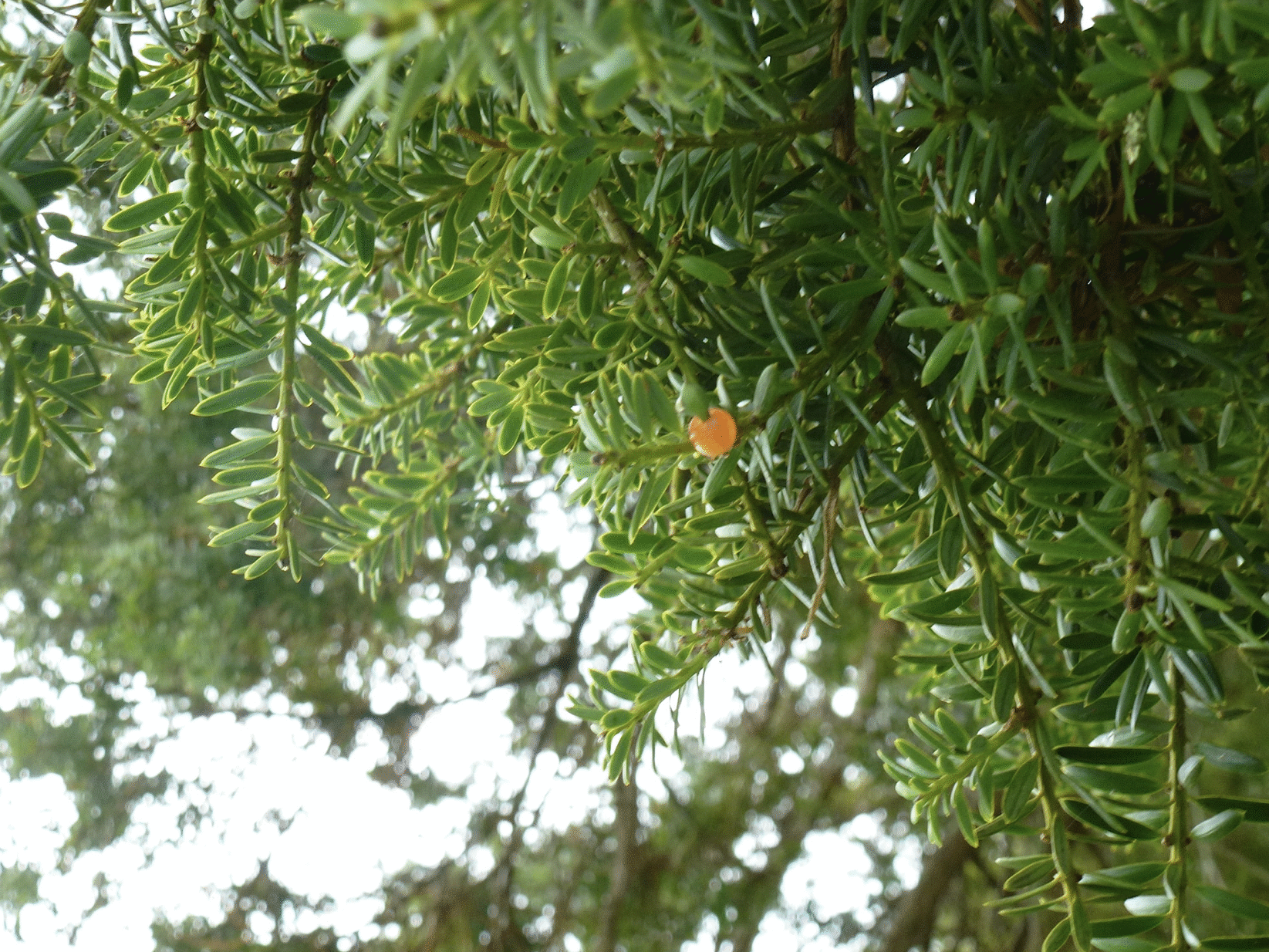
Left image: Succulent: Prickly tōtara leaves flank a cluster of ripening male cones
Right image: A female bright yellow cone is almost ripe enough to eat
The genus Podocarpus has about 82 species of trees and shrubs which are spread through-out the tropics and sub-tropics and further south into temperate regions. New Zealand has four endemic species, one of which, snow tōtara (Podocarpus nivalis), is a prostrate alpine shrub. Podocarpus means foot fruit, referring to the fleshy receptacle supporting the seed. Nivalis means growing at altitude.
The Māori name tōtara is derived from a Proto Oceanic word for spines and many Central Eastern Polynesian languages use it as a name for a porcupine fish (which is called koputotara by Māori). All New Zealand plants bearing the name tōtara have narrow pointed leaves resembling the exterior of a porcupine fish. In New Zealand tōtara refers to a magnificent forest tree with prickly leaves. Patotara is the name of a prickly-leaved prostrate shrub (Leucopogon fraseri).
Metaphorically, tōtara is also used to refer to a noble or highly esteemed person.